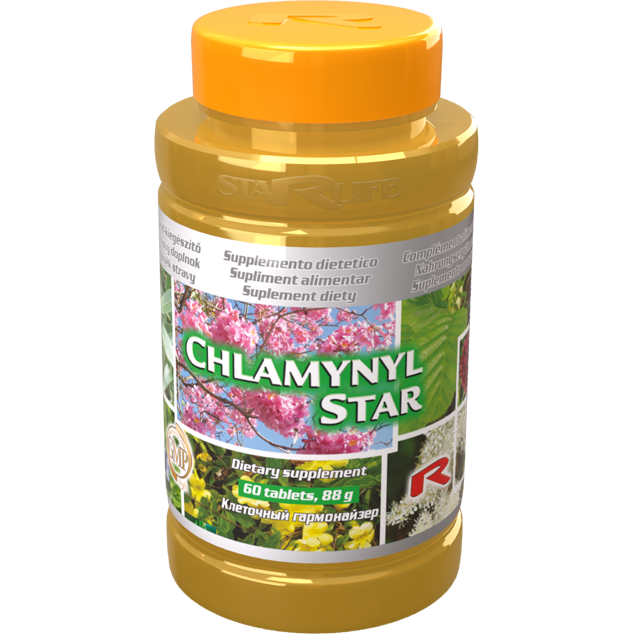
STARLIFE CHLAMYNYL STAR 60 cps
- Complete specifications
- Comments 0
- STARLIFE CHLAMYNYL STAR 60 cps1 den34 €/ ks
CHLAMYNYL STAR is carefully composed of plants with a long tradition in folk medicine., 60 tablets
The individual herbs and parts of the plants used in the product were selected so that their synergistic effect would be optimally effective.
Blood blood toten- Sanguisorba officinalis – occurs relatively abundantly throughout the north of Eurasia and the Pacific part of North America. In the past, blood blood was a valued medicinal plant, in folk medicine it was used primarily to stop bleeding, also "for inflammation" and "for varicose veins". It is still used in homeopathy today. It is also a good fodder plant. Interestingly, the bloodwort is the only food plant for the caterpillars of the swamp blue butterfly.
Filipendula ulmaria - elm meadowsweet is a well-known herb in folk medicine. Meadowsweet supports the body's defenses, especially against the action of microorganisms. It has a positive effect on overall health, calms and strengthens. It helps to suppress stress in an unfavorable environment. It has calming and relaxing effects, helps improve sleep quality. Last but not least, it has a positive effect on normal heart function, blood circulation and proper blood pressure levels.
In the tropical rainforests of Central America, a tall tree with smooth bark and tubular flowers grows, the Lapacho tabebuia, whose beneficial effects have been known to local indigenous tribes for centuries. The Indians call it a word that can be translated as "having power and strength". The modern history of lapacho dates back to 1884, when its most important constituent, lapachol, was isolated. The bark contains naphthoquinones and anthraquinones, which are substances that are rarely found together in one plant. The extraordinary effects are therefore attributed to their synergistic action. The most important naphthoquinone is lapachol, which has very positive effects. The discovery and success of the use of lapacho was so striking that the Brazilian government imposed an information embargo on the results of all clinical research related to lapacho. This embargo was only broken in 1981, and since then, interest in this plant has been increasing rapidly in the world.
Uncaria tomentosagrows in the tropical forests of the Amazon jungle up to heights of 800 m above sea level. It is a large, orange-flowered, light brown climbing plant, sometimes mistakenly called a vine. Its strong woody stem entwines other plants. At the base of each pair of leaves are thorns resembling a claw. This is why the plant is called "cat's claw". This plant has been attracting the attention of many biochemists, laboratories and doctors from all over the world for decades. The fame of this plant in Peru dates back to the ancient times of the Incas, who used it to treat many diseases and went down from the Andes to the jungle to get it. They revered it as a "Sacred Plant". According to an ancient legend, its discovery was due to a warrior of the Ashaninka tribe, who was seriously wounded and was making his way through the Amazon jungle. Weak and exhausted, he fell to the ground and awaited his end. But suddenly he saw an Amazonian tiger - Otorongo, who was tearing a strong liana with his claws and sharp teeth and drinking the juice that flowed out. After drinking, he jumped up with tremendous strength and caught a deer. The wounded man crawled to the same vine with all his strength, drank the juice and his strength immediately returned. He was amazed to see that "claws" similar to tigers were growing from the vine. Thanks to this legend, the name Uncaria tomentosa spread as "Uňa de gato", Cat's Claw", "Cat's Claw".
Salix alba - white willow - it is widespread in practically all of Europe, North Africa, Asia Minor. In the east it reaches the Yenisei and the Himalayas. White willow is also a well-known magical and medicinal plant, especially old and head-shaped willows often appear in myths and fairy tales. The healing effects of white willow were noticed as early as the 5th century BC by the Greek physician Hippocrates. The effects were scientifically proven by the Englishman Edward Stone in 1763. In folk medicine, it was mainly used as a relief for colds and "rheumatism". In 1838, salicylic acid was isolated from willow. However, it was not until artificially prepared acetylsalicylic acid, which was patented as Aspirin in 1899, that it gained greater application in medicine. It was the first synthetically prepared medicinal substance obtained based on knowledge of the natural contents of medicinal plants.
Recommended dosage
2 capsules 2 times a day.
Ingredients
Ingredients 4 capsules: Populus trenula linne (aspen poplar, bark, extract 10:1) 6,000 mg; emulsifier: microcrystalline cellulose; filler: calcium hydrogen phosphate; Sanguisorba officinalis (blackthorn, extract) 1,000 mg; Tabebuia serratifolia (Lapacho, Pau D'Arco, bark) 600 mg; Filipendula ulmaria (elm meadowsweet) 400 mg; Carica papaya (papaya powder) 400 mg; Uncaria tomentosa (Cat's Claw, bark powder) 200 mg; Bacopa monnieri (ground anchor) 160 mg; thickener: modified cellulose; stabilizer: cross-linked sodium carboxymethyl cellulose; antifoam: stearic acid; Salix alba (white willow; bark powder) 60 mg; Alnus glutinosa (glutinous alder; bark) 60 mg; anti-caking agent: magnesium stearate, silicon dioxide; bee propolis 40 mg; selenium (L-selenomethionine) 200 µg (364% of the reference intake).
Warning
Not intended for children under 3 years of age. The product is not a substitute for a varied diet. Avoid exceeding the recommended daily dosage. Keep out of reach of children! Store in a dry and dark place. Best before date indicated by EXP on the top of the package.